How to extract Salicin from willow bark
The bark of the plant is usually peeled off and dried under strict aseptic conditions. The dried bark is then extracted with 80% ethanol and 20%water. The hydro-ethanolic extract is then subjected to evaporation under reduced pressure. A condenser, a heating mantle, a round bottom flask and a vacuum pump would be used in a laboratory to extract Salicin.
Willow bark was used in the past to make aspirin but the modern way of synthesising aspirin is supposed to produce a higher percentage yield and a higher purity of aspirin.
Preparation of aspirin- how do you make 2-Ethanoyloxybenzenecarboxylic acid
-
Fill a large 600 ml beaker with approximately 500 ml’s of water and heat it over a Bunsen burner, on a tripod and wire gauze. Heat the water until it’s around 75°C.
-
Fill a squirt bottle with distilled water and place it inside a large beaker of ice water to chill.
-
Next weigh approximately 2.0 grams (record the exact mass) of hydroxybenzoic acid (salicylic acid) into a 50 ml Erlenmeyer flask. Measure out 5.0 ml’s of acetic anhydride in your graduated cylinder and pour it into the flask in such a way as to wash any crystals on the walls down into the bottom.
-
Add five drops of 85% phosphoric acid to serve as a catalyst.
Wash your hands
· Once the temperature of the water bath reaches 75°C, clamp the flask in place inside the water bath and heat for 15 minutes, stirring occasionally with a glass rod. Maintain the temperature of the water at 75°C throughout this process.
· Next cautiously add 2 ml’s of distilled water to the flask to decompose any excess acetic anhydride.
There may be some hot acetic acid vapours evolved as a result of this decomposition.
· When the liquid has stopped giving off vapours, remove the flask from the water bath and add 20 ml’s more of distilled water.
-
Let the flask cool on the bench for about 5 minutes, during which time you should see crystals of aspirin beginning to form.
-
After 5 minutes, place the flask into a beaker of ice water to speed up the process of crystallization and increase the yield of the product. Allow the flask to cool in the ice water for an additional 5 – 10 minutes.
-
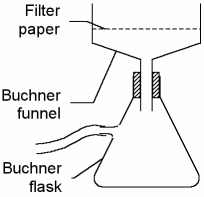
Collect the aspirin crystals by filtering the cold liquid through a Buchner funnel using a suction filter. Make sure you weigh the dry filter paper first. Use the chilled water from your squirt bottle to wash any remaining crystals from your flask into the funnel whilst filtering.
-
Rinse the crystals several times using the chilled water from your squirt bottle to help remove any impurities. Draw air through the filter for several minutes to help hasten drying of the crystals.
-
Then place the filter paper under a heat lamp to dry. Allow the crystals to dry for at least 30 minutes. Then Weigh the product and heat for an additional 10 minutes. The crystals are dry when they weigh the same each time i.e. when all the water has been evaporated.
-
The dry crystals should have a light flaky appearance. Clumpy crystals mean that they are still wet and need further drying. To speed up the drying break the clumps of crystals using your stirring rod.
If crystals are slow to form gently scratch the inside of the flask with a glass stirring rod
Testing the purity
Once the crystals are completely dry, test the purity using a Mel-Temp apparatus (melting point of your sample)
The simplist way to tell whether an organic compound is pure or not is to measure its melting point. A pure compound melts sharply, if impurities are present it melts more slowly and the melting point is lower than a pure compound.
The melting point of pure aspirin is 137.C. this means if the samples of aspirin made are 138.C -140.C you may have made aspirin if it is above or below slightly you may have some impurities in your sample or made something completly different. 2-hydroxybenzoic acid melting point is 158-160.C
To test the melting point take a capilliary tube and heat the end of it on a bunsen burner flame to seal the end. then tap the capilliary tube onto your sample to get the sample inside the tube, about 2 mm's will be enough.
Then place the capilliary tube into the Mel-temp apparatus and record the results of the melting point of your sample.
Repeat the same procedure for each of your samples. and record the results into a table.
And then follow the instructions on the Chromatohraphy page to complete a thin-layer chromatography. And follow the instructions on the titration page to complete a titration.
