Aspirin can be synthesised by the athanoylation (acetlyation) of 2-hydrobenzoic acid (salicylic acid), using phosphoric acid as a catalyst.When I have synthesized the aspirin, I could purify it by crystallization and filtration. This will mean I may lose some of the product, but good experimental technique will minimize the losses. If my aspirin was going to be used pharmaceutically it would require even further purification.
The main impurity in the crystallized aspirin will be salicylic acid, which will co-precipitate with the aspirin if the procedure is done too quickly.
Equation for synthesis
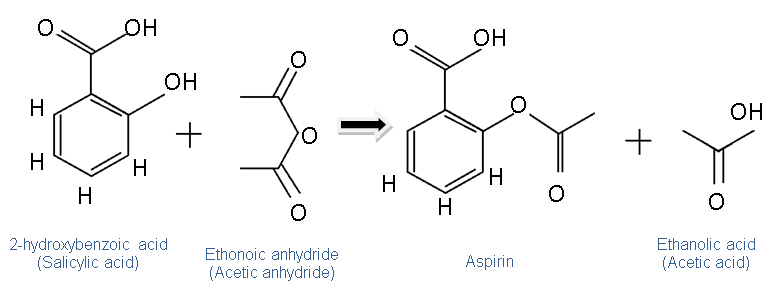
In 2-hydroxybenzoic acid (salicylic acid) there are 7 carbons, 3 oxygen’s and 6 hydrogen’s. Therefore the molecular mass of 2-hydroxybenzoic acid is 138.
In aspirin there are 9 carbons, 8 hydrogen’s and 4 oxygen’s. Therefore the molecular mass of aspirin is 180.
The mass of aspirin I should have is 180 x 0.0145 = 2.61g's
Using 0.0145 moles of hydroxybenzoic acid as the mass used is 2g’s with the molecular mass of 138 and 2/ 138 = 0.0145 It is the OH group of salicylic acid that reacts with the acetic anhydride to form an ester-like product. The carboxylic acid group of salicylic acid remains unchanged. Phosphoric acid will be used as a catalyst in this experiment.
